

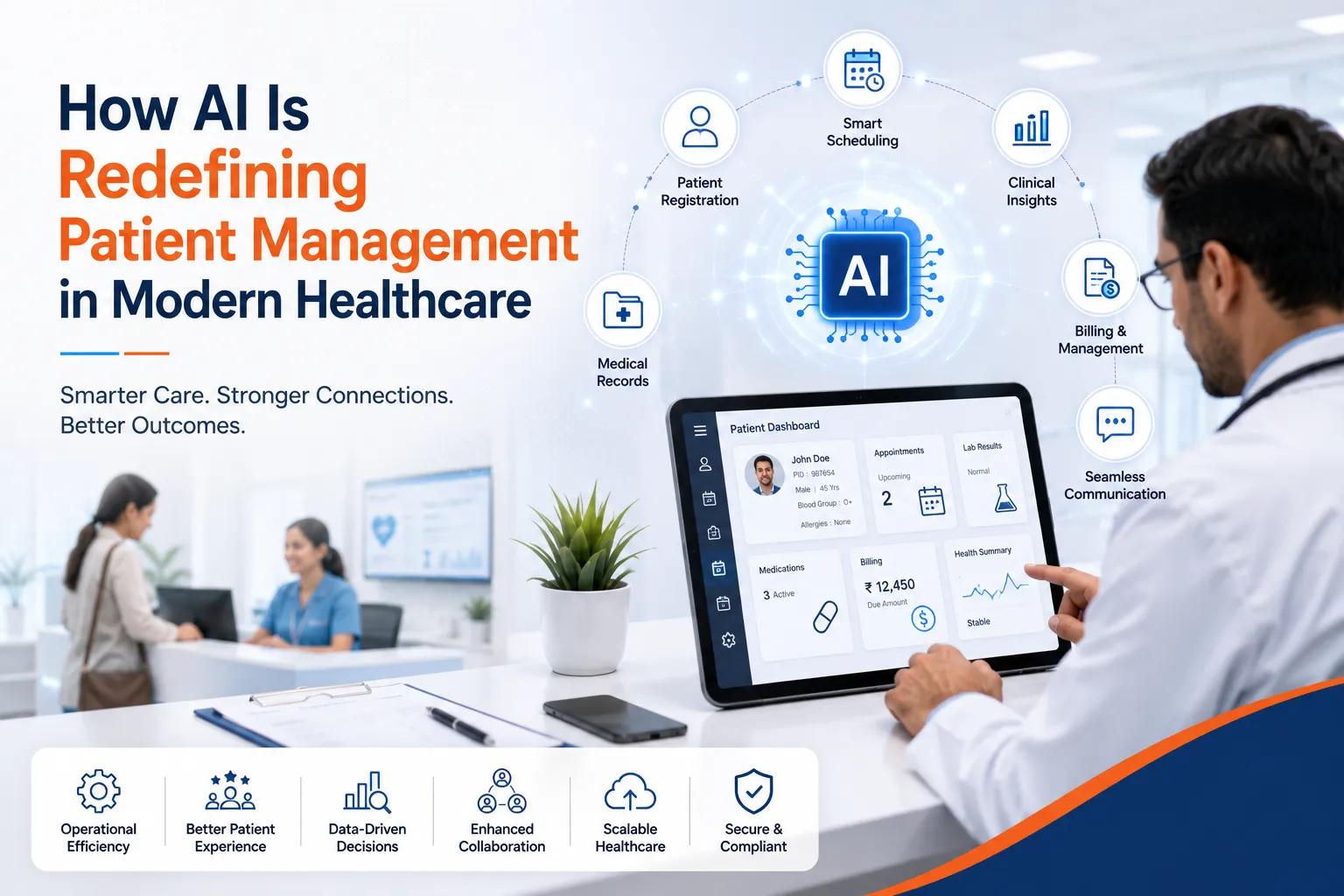
Healthcare has entered a new era where delivering quality patient care requires more than skilled medical professionals. Hospitals and clinics must also manage growing patient volumes, increasing administrative responsibilities, and the demand for faster, more personalized healthcare services. Traditional processes that rely on manual records, fragmented systems, and repetitive administrative tasks often create delays that affect both healthcare providers and patients.
Artificial Intelligence (AI) is changing this reality by making healthcare operations smarter, faster, and more connected. However, AI cannot deliver meaningful improvements on its own. It needs access to organized, real-time data, which is why a modern patient management system has become the foundation of digital healthcare.
By combining AI with intelligent patient management, healthcare organizations can simplify workflows, improve communication, and create better healthcare experiences from the first appointment to post-treatment follow-up.
Why Patient Management Is Evolving
Modern healthcare extends far beyond diagnosing and treating illnesses. Every patient interaction involves appointment scheduling, registration, medical history, laboratory testing, pharmacy coordination, billing, follow-up care, and communication between multiple healthcare professionals.
When these processes operate independently, hospitals often experience duplicated records, communication gaps, scheduling conflicts, and unnecessary administrative work.
A digital patient management platform brings these activities together, creating a connected environment where authorized healthcare teams can access accurate patient information whenever it is needed.
As healthcare continues to embrace digital transformation, intelligent patient management has become essential rather than optional.
What Is a Patient Management System?
A patient management system is a healthcare software solution that manages the complete patient journey through one centralized platform. It helps hospitals, clinics, diagnostic centers, and specialty healthcare facilities organize patient registration, appointments, medical records, treatment history, billing, prescriptions, and follow-up care.
Instead of maintaining information across multiple applications, healthcare providers can work with a single source of truth that improves collaboration and operational efficiency.
Modern solutions also integrate with Electronic Medical Records (EMR), Electronic Health Records (EHR), laboratory systems, pharmacy management, and healthcare ERP platforms to support connected healthcare delivery.
How AI Is Transforming Patient Management
Smarter Appointment Scheduling
Scheduling appointments manually often results in long waiting times, missed appointments, and inefficient utilization of doctors' schedules.
AI analyzes appointment availability, patient preferences, consultation duration, and scheduling patterns to help optimize calendars. Automated reminders also reduce missed appointments while improving patient convenience.
Faster Patient Registration
Manual registration creates repetitive paperwork and increases the possibility of data entry errors.
AI-supported digital registration simplifies information capture while reducing administrative workload. Returning patients can also experience faster check-ins because previous records are already available within the system.
Intelligent Clinical Decision Support
Healthcare professionals generate and access large amounts of patient information every day.
AI helps organize clinical data, identify patterns, and present relevant patient information that supports informed medical decision-making. Rather than replacing clinicians, AI enhances their ability to access complete and accurate information quickly.
Better Communication Across Departments
Patient care depends on effective collaboration between doctors, nurses, laboratories, pharmacies, radiology departments, billing teams, and hospital administrators.
A connected digital platform ensures every authorized department works with the latest patient information, reducing communication delays and duplicate documentation.
Benefits of Implementing a Patient Management System
Improved Patient Experience
Patients expect healthcare services that are efficient, transparent, and convenient.
Digital appointment booking, reduced waiting times, organized medical records, automated notifications, and smoother discharge processes contribute to a better overall patient experience while strengthening trust in healthcare providers.
Streamlined Administrative Work
Administrative tasks consume valuable time that healthcare professionals could otherwise spend on patient care.
Automation simplifies routine activities such as appointment management, patient registration, billing, document management, and report generation, allowing staff to focus on delivering quality healthcare.
Accurate Medical Records
Maintaining complete and organized patient records is essential for continuity of care.
A centralized platform provides authorized healthcare professionals with immediate access to consultation history, medications, allergies, diagnostic reports, and treatment plans, supporting informed clinical decisions and reducing unnecessary duplication.
Better Resource Management
Hospitals manage valuable resources including consultation rooms, hospital beds, medical equipment, diagnostic services, and healthcare professionals.
Real-time visibility into resource availability enables administrators to allocate resources more efficiently while minimizing scheduling conflicts and operational delays.
Data-Driven Healthcare Decisions
Modern healthcare organizations generate valuable operational data every day.
Integrated analytics help administrators monitor appointment trends, patient flow, department performance, resource utilization, and operational efficiency. These insights support continuous improvement and better strategic planning.
Choosing the Right Patient Management Solution
Every healthcare organization has unique operational requirements, making software selection an important strategic decision.
When evaluating a solution, consider whether it provides:
Digital patient registration
Appointment scheduling
EMR and EHR integration
Laboratory and pharmacy connectivity
Billing and financial management
Secure document management
Analytics and reporting
Role-based user access
Cloud accessibility
Scalability for future growth
Selecting a platform that integrates these capabilities helps healthcare organizations build a strong foundation for long-term digital transformation.
Why oeHealth?
oeHealth delivers an AI-powered healthcare ERP platform that integrates patient management, hospital administration, laboratory services, pharmacy, billing, inventory, finance, HR, and analytics into one connected ecosystem.
Designed for hospitals, clinics, diagnostic centers, and multi-location healthcare providers, oeHealth helps streamline operations, improve collaboration between departments, and simplify complex healthcare workflows. Its scalable architecture supports organizations as they expand while maintaining efficient, patient-centered care.
Final Thoughts
Artificial Intelligence is redefining healthcare by making patient management more connected, efficient, and data-driven. While AI provides intelligent automation and valuable insights, its true potential can only be realized when supported by a modern patient management system that connects every stage of the patient journey.
Healthcare organizations that invest in intelligent patient management today are better positioned to improve operational efficiency, strengthen collaboration, enhance patient experiences, and prepare for the future of digital healthcare.
Frequently Asked Questions
What is a patient management system?
A patient management system is healthcare software that manages patient registration, appointments, medical records, billing, treatment history, and follow-up care through a centralized platform.
How does AI improve patient management?
AI supports patient management by automating administrative tasks, improving appointment scheduling, organizing healthcare data, providing operational insights, and helping healthcare teams make faster, more informed decisions.
Who should use a patient management system?
Hospitals, specialty clinics, diagnostic centers, medical practices, and healthcare organizations of all sizes can benefit from implementing a patient management solution.
Can a patient management system integrate with hospital software?
Yes. Modern solutions typically integrate with EMR, EHR, laboratory systems, pharmacy management, billing platforms, and healthcare ERP software to create connected workflows.